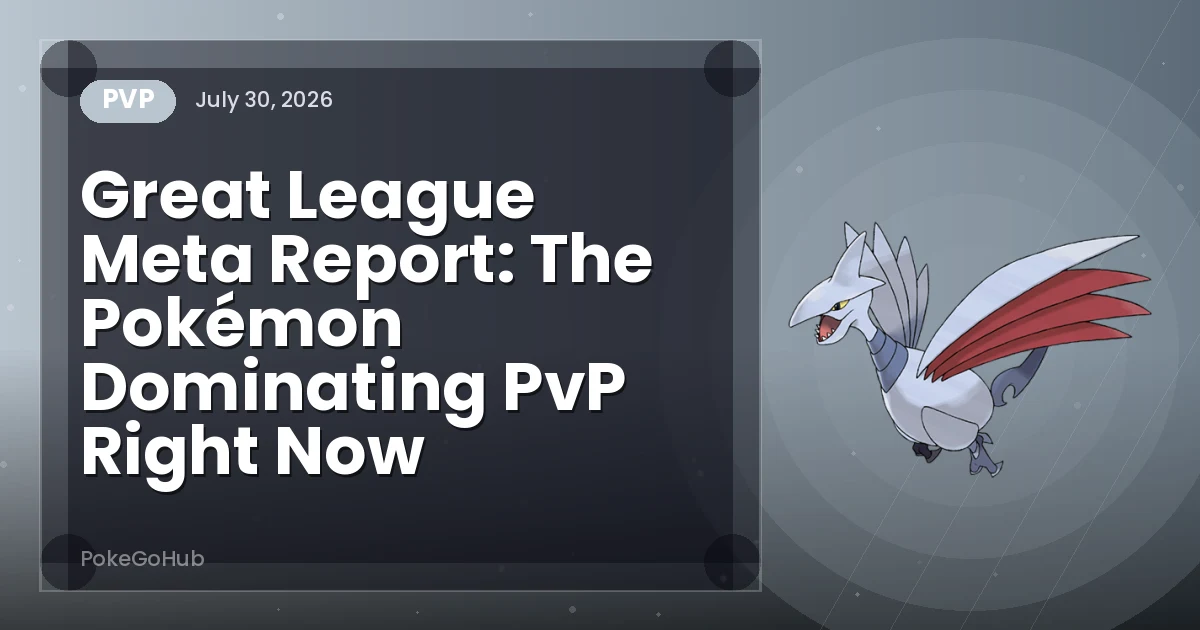
The Great League ladder shifts every time a new Pokémon gets a PvP-relevant move, a Community Day exclusive lands, or a rule change tweaks which Pokémon are even eligible. Here’s a snapshot of who’s currently defining the 1500 CP format, and why each of them earned that spot.
Current Great League Top Picks at a Glance
| Pokémon | Role | Why It’s Strong |
|---|---|---|
| Azumarill | Anchor | Water/Fairy typing with few exploitable weaknesses; fast energy plus Play Rough/Ice Beam coverage |
| Medicham | Pressure attacker | Strong bulk with Counter for consistent energy generation and wide coverage |
| Lanturn | Water/Flying answer | Unusual bulk for its typing; checks Water and Flying-type cores |
| Noctowl | Tank | High bulk and strong neutral damage; handles Ghost and Fighting-type attackers |
| Tinkaton | Niche punisher | Punishes Fighting and Dark-types leaning on physical attacks |
| Shadow Talonflame | Damage dealer | Shadow bonus adds extra pressure on top of a solid neutral moveset |
| Torkoal | Fire-type wall | Slow but extremely tanky; difficult to shield-bait effectively |
This snapshot reflects the current Forever Forward season of GO Battle League and will shift as new moves and rule changes roll out.
Azumarill — the format’s anchor
Azumarill has been a Great League staple for years, and it’s still here for good reason. Water/Fairy typing leaves it with very few exploitable weaknesses, its Fast Attack (Bubble) generates energy quickly, and the Play Rough plus Ice Beam combination covers an enormous share of the meta — Play Rough handles Dragon and Dark-type threats, while Ice Beam picks off Grass and Flying-types that might otherwise wall it. If you’re building your first competitive Great League team, Azumarill remains one of the safest first picks.
Medicham — bulk plus pressure
Medicham’s combination of solid overall bulk and the Counter Fast Attack (one of the best energy-generating moves in the format) makes it a consistently dominant pick. Running Counter alongside Ice Punch and Psychic gives it coverage against Steel, Dark, Ice and Normal-type opponents — a wide enough net that it rarely finds itself completely walled.
Lanturn — the rising answer to bulky Water/Flying cores
Lanturn has climbed the tier lists recently thanks to its unusual bulk for its typing and its ability to check both Water and Flying-type threats that other picks struggle against. It’s a good example of how the meta self-corrects: as more trainers leaned on Water/Flying cores, Lanturn’s specific counter-profile made it increasingly valuable.
Noctowl — the tank nobody expected
Few trainers would have predicted a few years ago that Noctowl — a Generation 2 owl most players ignored entirely — would become a legitimate top-tier Great League pick. Its surprisingly high bulk and strong neutral damage output let it handle Ghost and Fighting-type attackers that give many other picks trouble, and it’s cheap to build since Hoothoot is common enough to find good IV spreads without much searching.
Also worth building: Tinkaton, Shadow Talonflame and Torkoal
Rounding out the current top picks, these three each carve out a specific niche rather than being universal answers: Tinkaton punishes Fighting and Dark-types leaning on physical attacks, Shadow Talonflame brings fast, aggressive Fire/Flying pressure with the extra damage boost Shadow Pokémon carry into PvP, and Torkoal offers a slow but extremely tanky Fire-type wall that’s difficult to shield-bait effectively.
What this meta rewards
Looking at the picks above as a group, a pattern emerges: the current Great League format favors Pokémon that generate energy quickly, apply shield pressure early, and have enough natural bulk to survive a bad matchup long enough to find a good one. Pure glass-cannon attackers without defensive typing to back them up tend to underperform on the current ladder, even when their raw numbers look impressive on paper.
Building your own team
If you’re assembling a Great League roster from scratch, aim for type diversity across your three picks rather than three Pokémon that all share the same weakness. A common, reliable structure is one bulky “anchor” (like Azumarill or Noctowl), one fast-pressure attacker (like Medicham), and one specialized answer to whatever you expect to face most often on the ladder that week. Check your candidates’ PvP-specific IV rankings, not just their overall IV percentage — see our IVs Explained guide for why that distinction matters so much in capped formats like Great League.
Shields: the mechanic that decides most close matches
Each player enters a Great League match with two Protect Shields, which block all damage from a single Charged Attack when activated. Reading when your opponent is likely to shield — and baiting them into using a shield on a cheap attack so your stronger Charged Attack goes through unblocked later — is arguably a bigger skill gap between ranks than raw team-building. This is part of why energy-efficient Fast Attacks like Counter (on Medicham) and Bubble (on Azumarill) are so highly valued: they let you threaten a Charged Attack often enough to bait shields repeatedly over the course of a single three-minute match.
How the meta shifts over a season
Niantic periodically runs limited-time PvP cups with restricted rulesets (only certain types, CP ranges, or eligible species), which temporarily reshuffle what’s viable outside the standard Great League format. Outside of those cups, the open Great League ladder tends to shift more slowly, usually in response to new Community Day exclusive moves, newly released species, or balance changes to existing moves. It’s worth checking back on a report like this one every few weeks rather than assuming a snapshot stays accurate all season.
A note for brand-new PvP players
If you’ve never queued into GO Battle League before, don’t feel pressure to build a “meta” team on day one. The rank-based matchmaking system in the early ranks pairs you against similarly inexperienced opponents and rosters, so a team built from whatever strong, well-typed Pokémon you already have is a perfectly reasonable starting point. Prioritize learning the shield-baiting rhythm and switching decisions before investing heavily in optimizing IVs for a specific meta pick.
Related: if 1,500 CP battles aren’t your format, check the Ultra League meta report, the Master League meta report, the current Evolution Cup: Great League Edition rotation, or the full league comparison to decide which to play.





Comments are closed for this article.